The short version
- Most German startups stack their funding: a grant or stipend first, then business angels, then pre-seed or seed venture capital, often with a convertible loan in between.
- Check every programme's current terms before you plan around it: the INVEST acquisition grant, for example, only accepts complete applications until 31 December 2026.
- An equity round in a German GmbH ends at the notary and in the commercial register, so plan time for the legal close as well as for the pitch.
- Prepare the deck, a driver-based financial model, a clean cap table and a data room before the first meeting, and make the product ready for technical due diligence.
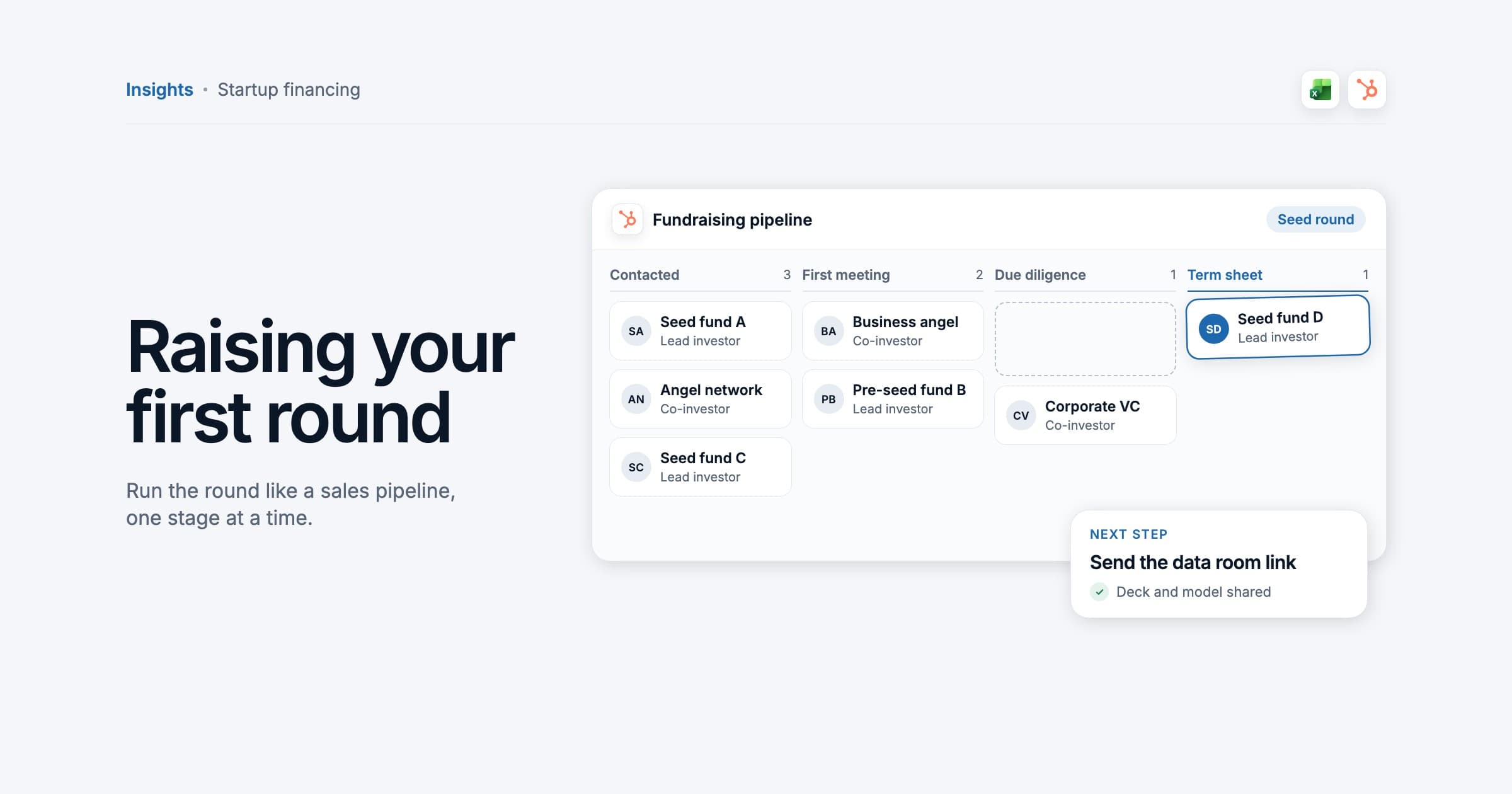
- Treat the investor list like a sales pipeline: research fit, prioritise, ask for warm introductions, run the meetings in a short window and track every step in a CRM.
General information, not legal or tax advice. Laws and deadlines change: check the sources and ask your lawyer or tax adviser before you act.
To raise money for a startup in Germany, most founders stack several sources rather than finding one investor. Typically that means a public grant or stipend such as the EXIST start-up grant to build the first version, then business angels (whose investment the federal INVEST programme can subsidise), then a pre-seed or seed round from venture capital funds such as High-Tech Gründerfonds, often bridged with a convertible loan. Whatever you raise, you need the same kit: a pitch deck, a financial model, a clean cap table, a data room and a product that survives technical due diligence.
Below: the stages and instruments, the programmes open in October 2026, what investors check, the documents, the investor list, the timeline and the mistakes that cost founders time and equity.
The funding stages and what each is for
Grants want innovation and a credible plan, angels want a team they believe in, and funds want evidence that the business can grow large. Matching the source to your stage saves months of pitching to the wrong people.
| Stage | Typical sources | Usual instrument | What you need to show |
|---|---|---|---|
| Idea and first version | Savings, revenue from early customers, EXIST or a state stipend | Own money, grants | A problem worth solving and a team that can build |
| Pre-seed | Business angels, angel clubs, pre-seed funds, public seed funds | Convertible loan or a small equity round | A working product, first users or pilots, a clear plan for the money |
| Seed | Seed VC funds such as High-Tech Gründerfonds, angels following on | Equity round, sometimes a convertible first | Early traction, a repeatable way to win customers, a credible team |
| Bank and public loans | KfW and ERP loans through your bank, state development banks | Loan, often with a public guarantee | A business that can service debt, usually with revenue |
Public money matters more in Germany than many founders expect. In the Deutscher Startup Monitor 2025, a survey of 1,846 startups, 45.0% said they already use public funding, which made it the most widely used external source; 31.3% had received money from business angels and 21.5% had raised venture capital.
Bootstrapping counts too: revenue from early customers is the cheapest capital you will ever raise, and paid pilots make every later conversation easier.
Grants and public programmes
Everything below was checked against the official programme pages in October 2026. Confirm the terms before you apply: guidelines are rewritten and budgets run out.
EXIST start-up grant
The EXIST-Gründungsstipendium from the Federal Ministry for Economic Affairs and Energy funds founders from universities and research institutions for 12 months before or around incorporation. Under the guideline of 18 April 2023 it pays €3,000 a month for doctorate holders, €2,500 for graduates, €2,000 for founders with a vocational qualification and €1,000 for students, plus €150 per child. Teams of up to three also get €30,000 for material costs (solo founders up to €10,000) and €5,000 for coaching. You apply through the start-up network of your university, not directly, and the company must not exist yet when funding starts.
State programmes
Every federal state runs its own programmes through its development bank or economics ministry. In North Rhine-Westphalia, for example, the Gründungsstipendium.NRW pays €1,200 a month for up to 12 months to up to three founders of an innovative company; a new guideline took effect on 1 October 2026. To find the programmes in your state, filter the federal Förderdatenbank by state and by "Existenzgründung".
KfW and ERP loans
The ERP-Gründerkredit StartGeld lends up to €200,000, of which up to €80,000 can be working capital, to businesses whose activity started no more than five years ago. KfW takes 80% of the credit risk, which makes banks more willing to lend, but you still apply through a bank or savings bank, not KfW. Note that KfW Capital, the group's venture arm, invests in venture capital funds rather than directly in startups.
The research allowance
Tech startups that do real research and development can claim the Forschungszulage, a tax-based subsidy for R&D projects that the BSFZ certifies. It is credited against your tax and any surplus is paid out, so it is worth checking even while you make losses.
Austria and Switzerland
In Austria, aws (Austria Wirtschaftsservice) funds early-stage companies through aws Preseed and Seedfinancing. In Switzerland, Innosuisse start-up innovation projects cover up to 70% of direct project costs for science-based startups that are under five years old and not yet selling their product.
Business angels, the INVEST grant and seed funds
Business angels
Angels are usually your first outside investors: experienced founders and managers investing their own money. The best bring introductions and judgement as well as cash. Ask each one what tickets they write and how they help after investing, then call one or two of their founders.
The INVEST grant for angels
With INVEST, the federal government refunds private investors 15% of what they pay for new shares in a young, innovative company, tax free, plus an exit grant of 25% of the capital gain (capped at the acquisition grant). The company must be under seven years old and small, and investors must invest at least €10,000. The investor applies to BAFA and must have the approval before investing; with a convertible loan, the grant is paid only after conversion.
Pre-seed and seed funds
High-Tech Gründerfonds, Germany's most active seed investor, says the sweet spot of its first investments in pre-seed and seed is €800,000 or more. It invests in companies no older than three years with their headquarters, or a base of operations, in Germany, in digital tech, industrial tech, life sciences, chemistry and related fields. Beyond HTGF there are private seed funds, regional funds backed by state development banks, corporate venture arms and angel syndicates. A fund's recent portfolio tells you more than its website.
Equity, convertible loans and SAFEs
Early rounds in Germany use two main instruments. An equity round sells new shares at an agreed valuation. A convertible loan (Wandeldarlehen) is a loan that turns into shares at the next priced round, usually at a discount and with a valuation cap. Y Combinator's SAFE also converts into shares automatically at a priced round, but it is written for US companies; German founders normally use a convertible loan.
For a GmbH the legal mechanics matter. A capital increase changes the articles of association, which needs a shareholder resolution recorded by a notary, and each new investor declares the shares they take up in a notarised declaration. The change takes effect when it is entered in the commercial register. Whether a convertible loan agreement itself must be notarised depends on how it is drafted, so have a lawyer review it. Free standard documents for financing rounds are published by GESSI, a joint project of Business Angels Deutschland and the Startup-Verband.
| Item | Equity round | Convertible loan |
|---|---|---|
| Money raised | €1,000,000 | €200,000 |
| Price | €4,000,000 pre-money valuation | Converts at the next round with a 20% discount, or at the cap if lower |
| Post-money | €5,000,000 | Not fixed until the next round |
| New investors' stake | €1,000,000 / €5,000,000 = 20% | Depends on the next round's price |
| Legal close | Investment agreement, shareholders' agreement, notary, commercial register | Loan agreement; notary and register at conversion |
Convertibles are faster and cheaper to close, which suits small bridge amounts. Their cost shows up later: several convertibles with different caps can dilute founders more than expected. Model every conversion in your cap table before you sign.
What investors look at
Early investors decide with little data. Sequoia's classic business plan outline lists the questions most investors work through: company purpose, problem, solution, why now, market potential, competition, business model, team, financials and vision.
- Team. Why you are the people to solve this, how complete the founding team is and how you work together.
- Problem and market. A specific customer with a painful problem, and a market large enough for the fund's return expectations.
- Evidence. Users, pilots, letters of intent, revenue or retention: whatever proves people want it. Real numbers beat projections.
- Product and technology. A working version, a defensible approach and an architecture that can grow without a rewrite.
- Business model. How you make money, what it costs to win a customer and what one is worth over time.
- The round. How much you raise, what milestones it buys and why those milestones justify the next round.
- Cap table. Founders who still own enough to stay motivated, and no large stakes held by people who no longer contribute.
The documents to prepare
Pitch deck
Ten to fifteen slides that follow the questions above. Send a version that works without you talking over it, and keep a presenting version for meetings. Put the ask (amount, instrument, use of funds) on its own slide.
Financial model and plan
A monthly model for at least the next 24 months, built from drivers you can explain (customers, prices, conversion, hires) rather than a top-down market share. Show the cash runway with and without the round, and a short written plan that ties milestones to spending.
Cap table
Every shareholder, share class, convertible and employee participation programme, with a pro forma version showing ownership after the round. It must match the shareholder list filed with the commercial register.
Data room checklist
- Commercial register extract, articles of association and the current shareholder list.
- Shareholders' agreements, previous investment and convertible loan agreements.
- Cap table, current and pro forma.
- Financial statements or management accounts, the financial model and bank statements.
- Key customer, supplier and partner contracts.
- Employment and freelancer contracts for the founders and key staff, including IP clauses.
- Trademarks, patents and domains, registered to the company.
- Grants received and their conditions, including any repayment obligations.
- Data protection documents: privacy notice, records of processing and data processing agreements.
- A technical overview: architecture, stack, hosting, security and the product roadmap.
Technical due diligence readiness
For a software startup, technical due diligence asks one question: is the product real, owned by the company and able to grow? Weak answers cost time and leverage.
Technical due diligence checklist
- All code in repositories owned by the company, with a readable history.
- IP from employees covered by law (§ 69b UrhG gives the employer the economic rights to software written in the course of the job); IP from freelancers and agencies assigned in writing as exclusive, unlimited rights of use.
- A working version an investor can log in to, on production infrastructure, not a demo on a laptop.
- An architecture overview and data model that a reviewer can follow in an hour.
- Automated tests and deployments, with releases going out regularly.
- Open source licences listed, with no licence that conflicts with your business model.
- Security basics: secrets out of the code, access controls, backups you have actually restored.
- GDPR basics: hosting region, processors and data processing agreements documented.
Building and working an investor list
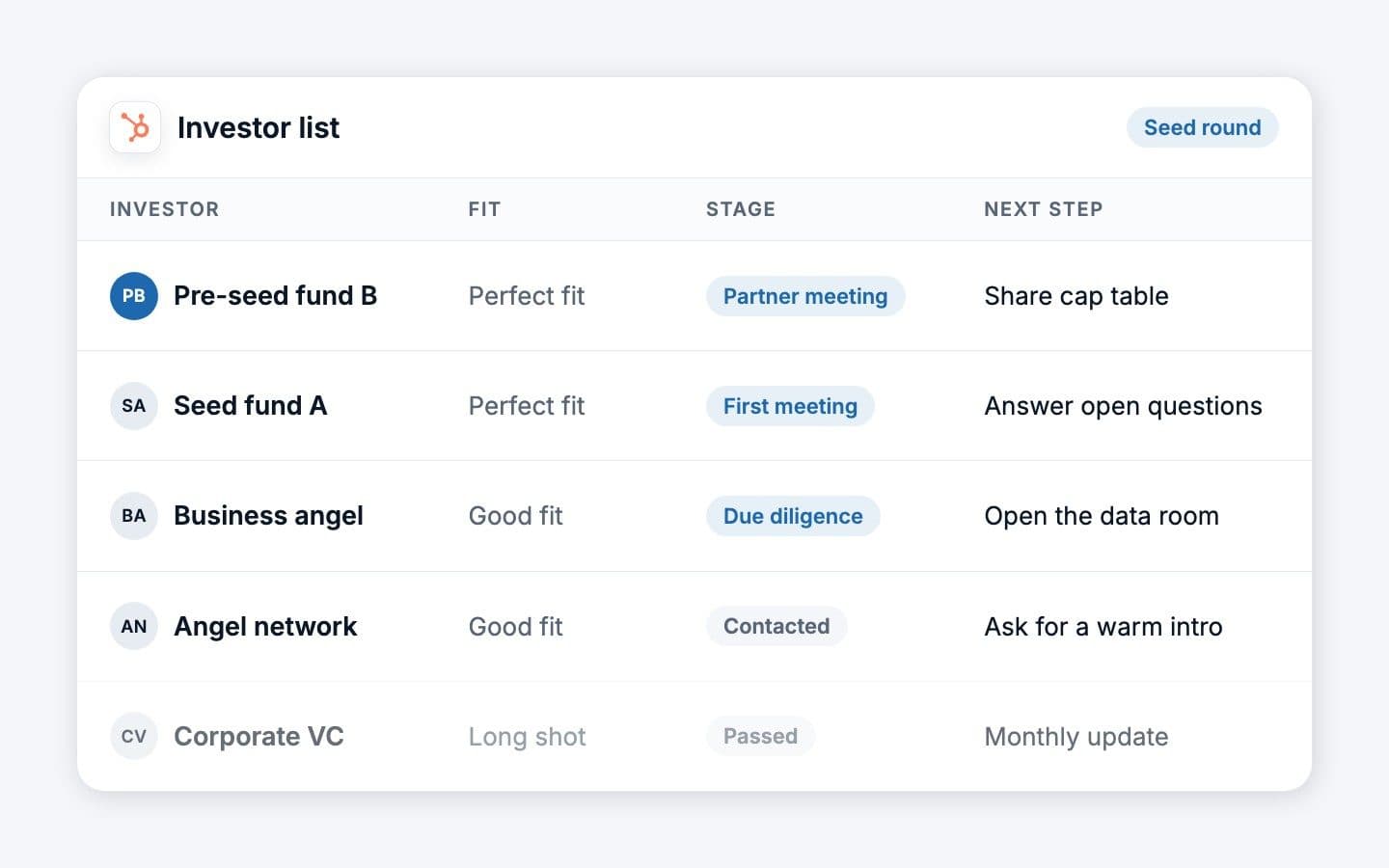
A round is a sales process with a very small market. Build the list before you need it and run it like a sales pipeline; a spreadsheet works for a first round, a simple CRM once you pass a few dozen names.
- Define the filter. Stage, ticket size, sector, geography and whether the investor can lead. A fund that never leads cannot start your round.
- Research. Use databases such as Crunchbase or Dealroom, fund websites, press releases of comparable rounds and the cap tables of companies like yours. Note the partner who covers your sector, not just the fund.
- Prioritise. Sort into tiers: perfect fit, good fit and long shots. Start with a few good-fit investors to sharpen the pitch before you meet your top tier.
- Get warm introductions. Ask founders they backed, your angels, advisers and university networks. A short forwardable email with three lines and the deck makes it easy to say yes.
- Run it in a window. Contact the whole priority list within two or three weeks, so that conversations move in parallel and interest builds at the same time.
- Follow up in writing. After each meeting, send the answers to open questions and a short update; send monthly updates to everyone who said "too early".
| Field | Why it matters |
|---|---|
| Investor, partner and contact route | Who you speak to and who introduced you |
| Fit and tier | Stage, ticket, sector and whether they lead |
| Stage of the conversation | Contacted, first meeting, partner meeting, due diligence, term sheet, closed or passed |
| Next step and date | The one action that moves it forward |
| Objections and open questions | Patterns tell you what to fix in the deck or the business |
The timeline of a round and common mistakes
Rounds take longer than founders plan for. The phases below are a planning example, not a promise.
| Phase | What happens | Plan for |
|---|---|---|
| Preparation | Deck, model, cap table, data room, product ready for review, investor list | 4 to 6 weeks |
| Outreach and first meetings | Warm introductions, first calls, follow-ups | 3 to 6 weeks |
| Partner meetings and term sheet | Deeper meetings, negotiation of terms, choosing a lead | 2 to 6 weeks |
| Due diligence and documents | Commercial, legal, financial and technical review; investment and shareholders' agreements | 3 to 8 weeks |
| Close | Notary, payment of the money, commercial register entry, grant paperwork | 1 to 4 weeks |
Common mistakes
- Starting too late. Raising with three months of cash left hands the negotiating power to the investor.
- Pitching the wrong investors. A fund that does not do your stage or sector costs you weeks and a contact you may need later.
- Sequential outreach. One investor at a time means no momentum and no competing interest.
- A cap table with problems. Too little founder ownership, unvested departed co-founders or a stack of uncapped convertibles all raise flags.
- A demo instead of a product. If the technical review finds code the company does not own, or a prototype held together by hand, the round slows down or reprices.
- Missing grant deadlines. Programmes such as INVEST require approval before the investment; signing first can cost your investors the grant.
- Skipping the lawyer. Templates help, but a lawyer and a tax adviser should check the round before you sign.
How Bespoke IT helps
We build first versions for startups, so the product side of the raise is in order: an architecture investors can review, a working version they can try and a codebase ready for technical due diligence. Through our partner Salford Ventures GmbH in Düsseldorf, founders also get help to strategise the raise, with the financial strategy, with preparing all the documents and with a list of investors. See how we work with startups or contact us to talk about your round.
Have a question about your own setup?
Ask our AI coworker. It answers in seconds and a person from our team follows up.

Bespoke One Coworker. AI assistant. Answers in seconds, estimate in three minutes.